
Used car financing requirements in Virginia: 2026 guide
Used car financing requirements in Virginia
Financing a used vehicle in Virginia is rarely determined by a single number. Many buyers begin the process asking what credit score they need, but lenders can evaluate a broader financial profile that includes credit history, income, the amount being financed, the vehicle itself, and the structure of the transaction. There is no universal credit score that guarantees approval across every lender.
Understanding the used car financing requirements in Virginia before selecting a vehicle can make the buying process more predictable. It also helps buyers distinguish between qualifying for financing and receiving financing terms that make sense for their circumstances. Usautos can help customers explore vehicles and available financing paths together rather than treating them as completely separate decisions.
That distinction has become particularly relevant in 2026. Experian’s Q2 2026 data shows an average credit score of 688 among used-vehicle borrowers, an average used loan amount of $27,852, an average payment of $542, and an average interest rate of 11.19%. Those figures describe the national market; they are benchmarks, not minimum requirements or financing terms guaranteed to an individual Virginia buyer.
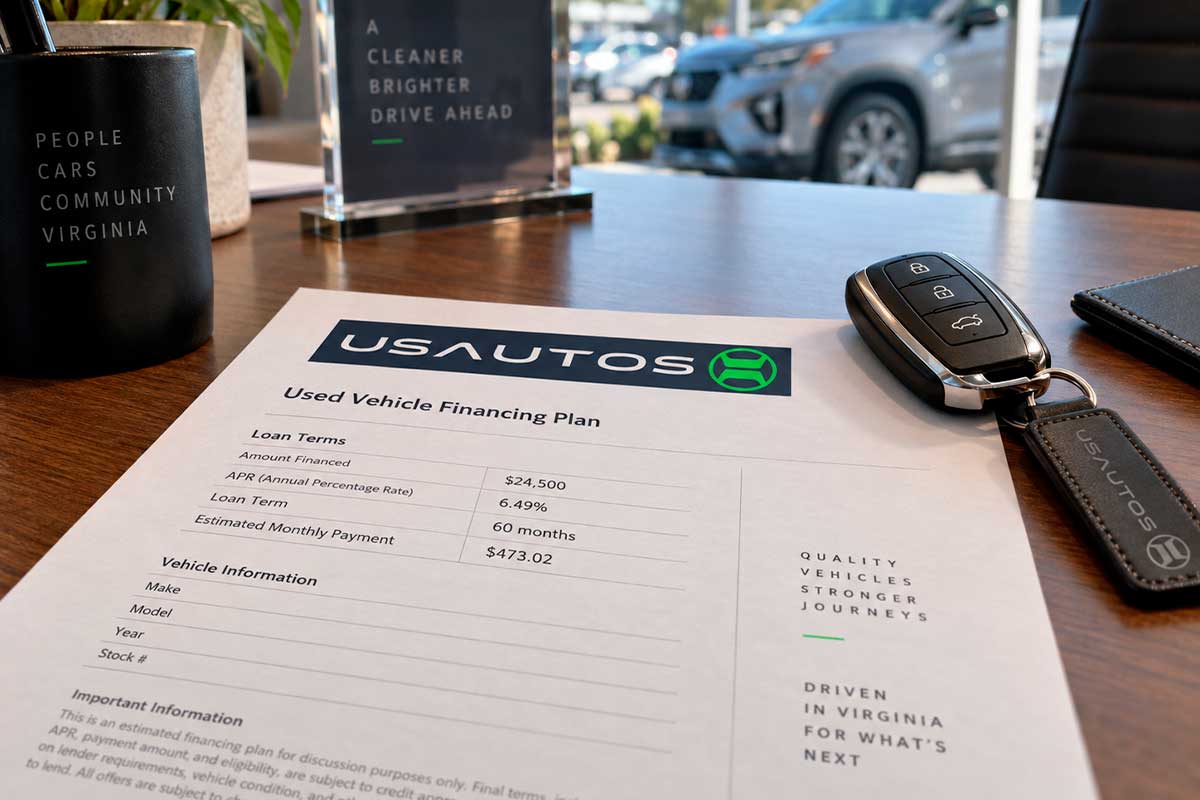
What credit score do you need to finance a used car?
There is no single minimum credit score required for every auto loan. Banks, credit unions, finance companies, dealerships, and other lenders can establish their own underwriting requirements. Some lenders may use firm score thresholds, while others can evaluate the score alongside factors such as the amount borrowed and down payment.
Experian reported an average VantageScore of 688 for used-car borrowers in Q2 2026. That number should not be interpreted as saying that a buyer needs a 688 score to finance a vehicle. An average describes borrowers in the dataset, while a lender requirement determines whether a particular application fits that lender’s criteria.
This distinction matters for customers who assume that being below an average automatically prevents them from financing a vehicle. It also matters for buyers with higher scores: stronger credit may improve access to competitive terms, but it does not mean every lender will offer the same APR, loan amount, term, or down-payment structure.
What do lenders look at when financing a used car?
A credit score summarizes part of a consumer’s credit profile, but the financing decision can extend beyond that score. The exact criteria vary by lender, which is why two customers interested in similarly priced vehicles may receive different financing structures.
Three broad areas can influence an application:
- Credit profile and payment history: the score, previous credit behavior, and depth of available credit history can influence how a lender evaluates risk.
- Income and ability to repay: income information and other financial obligations may help determine whether the proposed payment fits the applicant’s situation.
- Vehicle and financing structure: purchase price, amount financed, down payment when applicable, vehicle age, mileage, and lender-specific criteria can affect available terms.
This is a more useful way to understand used car financing requirements in Virginia than searching for one universal approval formula. The requirements that matter are ultimately those applied by the lender evaluating the specific buyer and transaction.

Getting approved and getting favorable financing terms are different
One of the most important distinctions in auto financing is the difference between Can I get financed? and What financing terms could I receive? Approval answers the first question. APR, loan term, amount financed, required down payment, and monthly payment begin answering the second.
Recent Experian data illustrates how significant that difference can be. In Q2 2026, average used-car APRs were 6.29% for super-prime borrowers, 8.81% for prime, 13.93% for near-prime, 19.10% for subprime, and 21.62% for deep-subprime borrowers, using VantageScore 4.0 categories.
These are national averages, not rates offered or guaranteed by Usautos. An individual offer can differ based on the lender, applicant, vehicle, amount financed, market conditions, and other underwriting factors. The figures are useful because they demonstrate why credit profile can affect the cost of borrowing even when two people are both able to obtain financing.

Does income matter when financing a used car?
Income can be relevant because a lender needs to evaluate more than past credit behavior. A customer might have an established credit history but still be considering a vehicle whose payment is difficult to support relative to the financial information provided in the application.
There is no universal salary that automatically qualifies someone to finance a used car. A $40,000 annual income, for example, cannot be evaluated meaningfully without knowing the amount being financed, other financial obligations, proposed loan structure, and lender requirements. The vehicle selected changes the equation as well.
Accurate information becomes important during this stage. When a lender requests income, residence, identity, or other supporting documentation, inconsistencies can require additional verification and affect how quickly an application can be evaluated.
How does a down payment affect used car financing?
A down payment reduces the amount that needs to be financed. The Federal Trade Commission specifically notes that putting money down can reduce the amount borrowed and lower the total financing cost.
That does not mean there is a universal down payment that guarantees approval. A lender may consider the complete transaction differently depending on the applicant and vehicle. Buyers should be cautious about reducing the entire financing decision to questions such as “How little can I put down?”
The more complete comparison includes the vehicle’s price, down payment, APR, amount financed, loan term, and monthly payment. The FTC advises consumers to focus on total cost rather than the monthly payment alone because longer loan terms can reduce the payment while making the financing more expensive overall.
Why does the car you choose affect your financing application?
The vehicle is part of the transaction being financed. Price, model year, mileage, condition, and the amount the customer needs to borrow can influence the financing structure available under a particular lender’s requirements.
This creates an important connection between vehicle shopping and financing. A buyer who first chooses a vehicle significantly outside a realistic budget may have fewer practical options than someone who compares cars while considering the financing structure from the beginning.
At Usautos, customers can compare used vehicles at different price points while exploring the financing alternatives that may correspond with their situation. Easy financing is more useful when it helps connect the customer with an appropriate vehicle and available financing path rather than creating the expectation that every applicant receives identical terms.

Limited credit history is different from bad credit
A limited credit file and a history containing negative credit events are not necessarily the same situation. Someone who recently started building credit in the United States may simply have fewer accounts and less historical information available than a consumer who has used credit products for many years.
A buyer with missed payments or other adverse information presents a different credit history. How much weight a lender gives these circumstances depends on its underwriting standards, so neither situation should automatically be labeled as an approval or rejection.
This distinction is particularly useful for people who are relatively new to the U.S. financial system. Instead of assuming that limited history means there are no alternatives, the buyer can determine what information is available and explore financing programs for which they may qualify.
Can you finance a used car with an ITIN in Virginia?
Some buyers searching for a vehicle in Virginia do not have a Social Security Number but do have an Individual Taxpayer Identification Number. Certain financing programs may consider applicants using an ITIN, although requirements and availability depend on the lender.
An ITIN itself does not guarantee financing. Lenders may still evaluate income, documentation, the selected vehicle, down payment when applicable, and other elements of the transaction. Usautos can help customers explore financing alternatives that may be available through participating financial partners, subject to their requirements and approval.
For customers researching Easy financing, this is an important distinction. A more useful dealership experience is one that helps the applicant understand which path may apply to their situation rather than relying on a blanket promise of approval.
What should you prepare before applying for used car financing?
Preparation does not guarantee financing, but it can give the buyer a clearer picture of what they can reasonably pursue. It can also reduce uncertainty when documentation is requested during the application process.
Before applying, focus on three areas:
- Know your current financial situation: understand your credit profile, realistic monthly transportation budget, and how much money you are comfortable putting toward a down payment.
- Prepare accurate information: have identification, income, residence, and other supporting information that may be requested for your particular application.
- Keep the vehicle budget realistic: compare vehicles whose price and expected ownership costs make sense for your finances instead of shopping exclusively around the maximum amount you hope to borrow.
Consumers can also review their credit reports before shopping. The FTC recommends checking the information that may affect loan eligibility and borrowing costs before visiting a dealership.
How Usautos can help different credit profiles buy a used car
Usautos can bring vehicle selection and financing into the same conversation. Instead of selecting a car first and trying to force the financing around it afterward, customers can compare available vehicles while considering price, budget, documentation, and the financing alternatives that may be available for their profile.
This approach can be useful for established-credit customers, buyers with limited credit history, and certain ITIN applicants. Financing remains subject to lender requirements and approval, but guidance during the process can help customers understand what information is needed and what the proposed financing actually means.
The Usautos buying experience can focus on three practical advantages:
- Used cars for different budgets: compare vehicle alternatives according to price, practical needs, and the financing structure being considered.
- Financing options for different credit profiles: explore programs that may be available based on the applicant’s situation and participating lender criteria.
- Bilingual financing guidance: receive support understanding the application, requested information, and financing conditions before completing the purchase.
This positioning is especially important in a market where the average used-car borrower is financing more than $27,000 nationally. The objective should be to find a vehicle and financing structure that make sense together, rather than treating approval itself as the finish line.
How long does car financing take in Virginia?
¿Te animas? Escríbenos o visítanos hoy mismo. Tu próximo paso en este país empieza sobre ruedas.
FAQs
Can a down payment help if I have limited credit history?
A down payment reduces the amount that needs to be financed and can change the structure of the transaction. Whether it improves approval prospects or specific terms depends on the lender and applicant, so there is no universal down-payment amount that guarantees financing.
Does having a higher credit score guarantee a lower car payment?
No. Credit can influence the APR and available terms, but the monthly payment also depends on the vehicle price, down payment, amount financed, loan duration, and other conditions. A higher score by itself does not determine the final monthly payment.
Can I finance a used car with a credit score below 600?
Financing may be available to some borrowers with scores below 600, but approval and terms depend on the lender and complete application. Experian’s Q2 2026 market data includes both subprime and deep-subprime used-car financing, although average APRs for those tiers were considerably higher than for prime borrowers.
What credit score is required to finance a used car in Virginia?
There is no universal minimum credit score for every used-car loan. Individual banks, finance companies, credit unions, and other lenders can establish their own requirements. Experian reported an average score of 688 among used-car borrowers in Q2 2026, but that is a national average rather than a minimum qualification threshold.

